
When the Semester Doesn’t Go as Planned: Executive Function Tools Every College Student Needs.
- Lisa Sydney

- Nov 28, 2025
- 4 min read
Updated: Dec 22, 2025

Why is it that you can hyper-focus on a video game for six hours, but reading one page of a textbook feels physically painful?
It’s not because you’re a "bad student" or "lazy." It’s because college strips away the external structure you had in high school and demands that your brain builds it from scratch.
In high school, your environment was your executive function. Teachers reminded you of deadlines, bells told you when to switch tasks, and parents likely helped manage your mornings. Now? You are the CEO of your own life, and nobody trained you for the job.

If you feel like you're failing, it’s simply because your executive function skills haven't caught up to your workload yet.
When the semester starts sliding off the rails and managing college stress feels impossible, you don't need to "try harder." You just need better executive function tools for college students.
The Real Need for Executive Function Tools for College Students
In high school, your environment was your executive function. Teachers reminded you of deadlines, bells told you when to switch tasks, and parents likely helped manage your mornings. Now? You are the CEO of your own life, and nobody trained you for the job.
If you feel like you're failing, it’s simply because your executive function skills haven't caught up to your workload yet.
When the semester starts sliding off the rails and managing college stress feels impossible, you don't need to "try harder." You just need a better system.
Here are 5 strategies to help you hack your brain and get back on track.
1. Stop Managing Time. Start Managing Energy.
Be honest: How many color-coded planners have you bought and abandoned by Week 3?
Traditional time management strategies for students often fail because they treat you like a robot. You schedule "Study Biology" for 2:00 PM. But if 2:00 PM is right after a heavy lunch and a stressful class, your brain is offline.
The Fix: Energy Mapping Don't just look at the clock; look at your battery level.
Find your "Power Hours": Are you a morning lark or a night owl? Schedule your hardest, ugliest tasks (like writing papers) during your peak energy window.
Respect the slump: If you know you crash at 3 PM, stop trying to force yourself to read Shakespeare then. Use that time for low-energy tasks like laundry or email.
The Red/Green Rule: Look at your calendar. If you see a solid block of "work" (Red) without any "rest" (Green), you are architecting your own burnout.

2. Hack Procrastination (Because You Aren't Lazy)
Procrastination is not a "laziness" problem. It is an anxiety problem.
When you stare at a task like "Write 10-page Thesis," your brain's fear center (the amygdala) screams, "THREAT! TOO BIG! RUN AWAY!" So, you open Instagram to soothe the anxiety.
To master overcoming procrastination in college, you have to lower the threat level.
The Fix: The "Low Floor" Method Make the task so stupidly small that your brain can’t say no.
Don't "write the essay." Just open the Google Doc.
Don't "study for the final." Just read one paragraph.
Don't "clean the room." Just pick up two socks.
Tools to help: If your brain refuses to break things down, use Goblin Tools. It’s a free AI tool with a "Magic To-Do" button that turns "Write Paper" into a step-by-step checklist of tiny, spicy tasks. It is arguably one of the best planning and organization tools for students available right now.
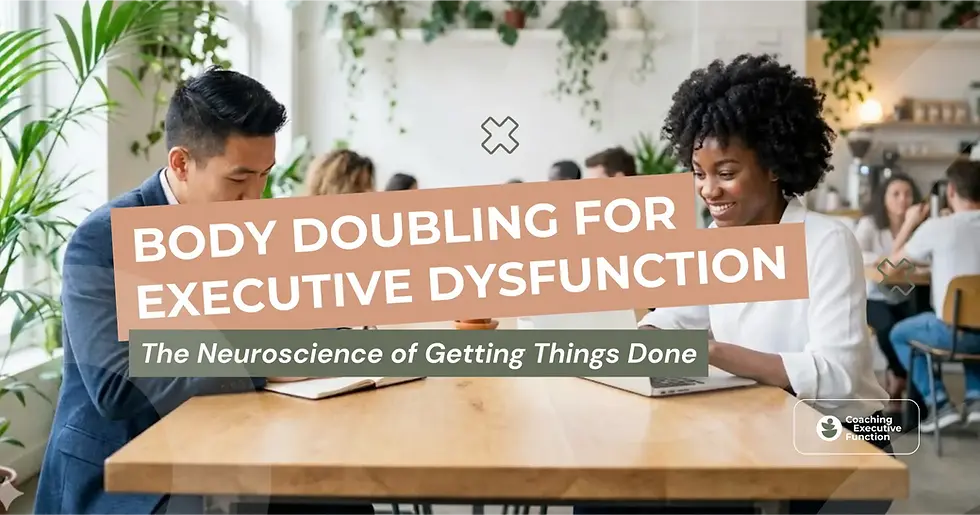
3. Outsource Your Willpower (Body Doubling)
Willpower is a battery, and by the afternoon, yours is empty. Stop trying to white-knuckle your way through distractions. Use your social instincts instead.
The Fix: Body Doubling This is one of the most effective ADHD-friendly study habits, but it works for everyone. It simply means working in the presence of someone else.
The Silent Pact: Grab a friend, sit down, and agree: "No talking for 45 minutes."
The Library Effect: Go to a space where everyone is working. Your brain has "mirror neurons" that will mimic the focus of the people around you.
Gamify Focus: Download the Forest app. You plant a digital tree when you start working. If you leave the app to check TikTok, your tree dies. (Don't kill the tree. It’s sad.)
This provides executive dysfunction support by using external pressure to keep you on track.
4. Be a GPS, Not a Judge
Here is a guarantee: You will miss a deadline. You will bomb a quiz. You will sleep through an alarm.
The difference between students who graduate and students who burn out isn't perfection; it's cognitive flexibility. When you mess up, do you shame yourself ("I'm such an idiot"), or do you pivot?
The Fix: The "Recalculating" Mindset Think of your semester like a GPS. If you miss a turn, the GPS doesn't scream, "You are a failure! Turn the car around!" It simply says, "Recalculating..." and finds the next best route.
Neutralize the shame: Shame freezes executive function. Treat a bad grade as data, not a definition of your worth.
Email the professor: Do it before the panic sets in. "I'm struggling with this timeline, can we discuss a plan?" is a mature move, not a weak one.
5. Respect the Burnout Cycle
There is a weird culture in college that glorifies the "all-nighter." Let’s be clear: student burnout signs—like apathy, exhaustion, and cynicism—are not a badge of honor. They are signs your system is crashing.
You cannot focus if your brain is in survival mode.
The Fix: Recovery is a Strategy Academic burnout recovery isn't about "doom scrolling" for three hours. That’s numbing, not resting.
Sleep: It cleans the metabolic waste from your brain. It is non-negotiable.
Movement: A 10-minute walk resets your dopamine levels better than a Monster energy drink.
Sensory Quiet: If you are overstimulated, sit in a dark room for 5 minutes. No phone. Just quiet.
You cannot pour from an empty cup. Protecting your peace is an academic strategy.

The Bottom Line: You Are Becoming
If this semester feels messy, that’s okay. Those students who look like they have it all together? They aren't superheroes. They have just learned to build a brain management system that works for them.
You aren't failing. You are learning.
Pick one tool from this list. Just one. Set a timer. Start small. Success in college isn’t about never messing up,it’s about how quickly you bounce back.
You’ve got this. Now, go show this semester who’s boss.
Comments