Cognitive Load Management: Building Operational Scaffolding for High-Performance Teams


As each fiscal quarter draws near, office leadership and management set big, audacious and even strategic objectives for their team. They many times combine the unfulfilled goals of the current quarter with their hopeful plans for the next quarter hoping to make up for mistakes made and even turn the entire year around off the new quarter.
Leadership often does this from a place of perceived high-level cognitive clarity and competence of their employees. Their plans and the initiatives that accompany them fail to take into account one or more of; market instability, office executive function levels or team alignment and capacity in executing the vision laid out. This ‘North Star’ they have laid out for the organization is based on an idealized version of everyone who is going to be involved in the journey there. And very often, reality does not go that way.

A few weeks later, real life shows up, actual market conditions and workers executive function and capacity have to implement those initiatives. The result is often a repetition of what occurred in the previous quarter. Decision-making fatigue hit, the roadmap to the ‘North Star’ becomes blurrier and blurrier as the ensuing chaos uses up every last bit of available cognitive resource. The volume of micro-decisions, slack pings, pivoting priorities, and administrative overhead, depletes the very cognitive resources required to execute the original vision. When the inevitable "crash" happens, it’s rarely a lack of commitment; it’s a failure of Cognitive Architecture.
If the implementation of your company's strategic initiatives often stalls after the kick-off or in the very least, fails to lead you towards the goals you have outlined for the company, it isn't a leadership failure, this is a manifestation of Executive Dysfunction.
The problem is that most organizations plan strategy at the level of ambition, but execute at the level of cognitive capacity. Strategy fails when it outpaces cognitive capacity, teams are then forced to rely on individual memory, willpower, and informal coordination to bridge the gap.
That gap is where initiatives stall, alignment fractures and high performers quietly burn out , bearing the brunt.
Without scaffolding, even the most competent teams will struggle under the weight of constant ambiguity and reactive work. With it, strategy becomes executable. Operational scaffolding is the way to go in order to turn strategic intent into structured workflows, clarified decision rights, documented processes, defined priorities, and realistic pacing. It is the means of ensuring that the path to the “North Star” is not solely dependent on heroic effort.
The question, then, is not whether your team is capable. The question is whether your operating system supports their executive function or silently drains it.
Cognitive load management is the missing variable in most strategic planning conversations, and the organizations that treat it as a core resource will execute more reliably than those that don't.
Cognitive Load Management as a Resource Allocation Issue
When setting strategic goals and creating initiatives to achieve them, available resources are always taken into consideration and in many companies, the resources acknowledged are mostly financial and operational. Leadership evaluates budget constraints, headcount distribution, tooling, and timelines. These are considered the most primary variables that determine execution capacity.
However, in knowledge-driven environments, there is another critical resource that is rarely measured with the same rigor: cognitive bandwidth.
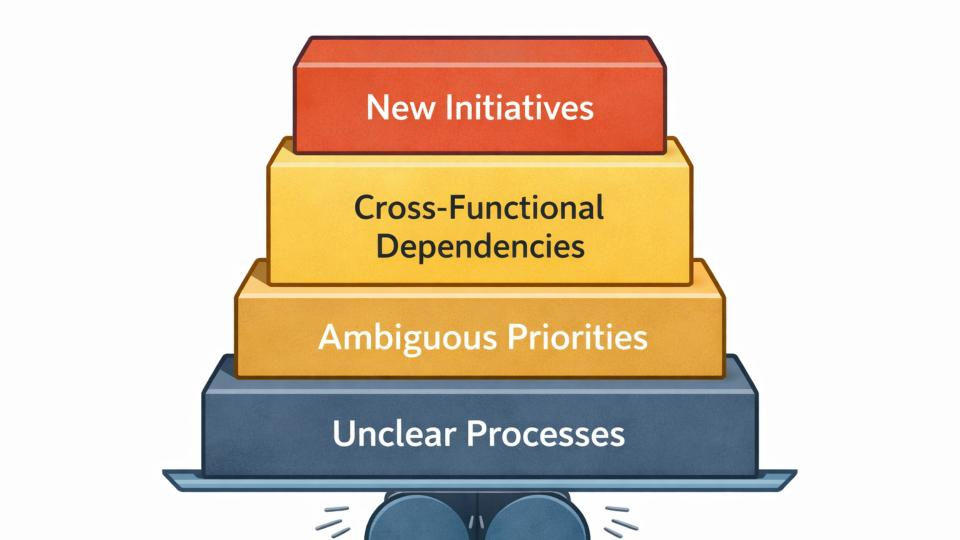
Modern work runs on attention, decision-making capabilities, and sustained executive control. And what is poorly evaluated about these is that they are not infinite resources. They are finite, fluctuating, and highly sensitive to environmental design.
Every new initiative consumes cognitive load. Every cross-functional dependency increases working memory demands. Every ambiguous priority forces additional decision-making cycles. Every unclear process transfers planning responsibility to the individual contributor.
And what happens when a company's vision expands scope without recalibrating cognitive load on their employees, is not simply additional work load for the assigned individuals, it is increasing strain on executive function.
When the employees then inevitably fall to executive dysfunction, what manifests as underperformance is recurrent build up of cognitive saturation.
In many organizations, the same high-capacity individuals absorb disproportionate executive load, compensating for missing structure by holding more in working memory, resolving ambiguity informally, and making micro-decisions that should have been systematized. Over time, this creates invisible fragility in the organization’s operating model which time after time, becomes evident when they leave.
Cognitive load, like financial capital, must be budgeted.
If a strategy requires more sustained decision-making, prioritization, and ambiguity management than the system can structurally support, execution will fragment, irregardless of talent density or commitment levels.
When budgeting cognitive load, the central question becomes:
Not “Do we have enough people?” Not “Are our teams motivated?”
But:
Does our operational architecture distribute cognitive demand sustainably?
When cognitive bandwidth is treated as a primary resource, measured, protected, and scaffolded, strategic execution becomes more predictable. The line from where you are to the land promised by the ‘North Star’ becomes clearly attainable and everybody arrives in one piece.
Modern leadership requires financial intelligence, strategic clarity, and operational foresight. It also requires cognitive design.
Workplace Executive Function vs. Individual Executive Function
Cognitive load improperly distributed becomes the problem of the individual, and scape "goatism" becomes the order of the day. Workers are then subjected to performance improvement plans, time management training, training to use productivity tools and more resilience workshops.
While these interventions may provide marginal benefit, they frequently miss the structural issue: executive demand has outpaced executive design (to an extent that even individual executive function cannot pick up the slack) .
It is then critical to distinguish between individual executive function and workplace executive function .
Individual executive function refers to a person’s cognitive abilities: the person’s capacity for planning, task initiation, utilizing working memory, emotional regulation, and cognitive flexibility.
Workplace executive function refers to how an organization structures, distributes, and supports those same cognitive demands at scale pursue a purpose. Individual executive function is the bullet, with its steel metal body housing a gun powder, while the workplace executive function is the gun firing the bullet, guiding its direction and giving it aim.
What directly affects productivity is not only if employees can prioritize but whether priorities are architecturally clear.
When workplace executive function is underdeveloped, the organization relies heavily on informal coordination, personal memory, and real-time problem solving. This creates a dependency on cognitive heroics; individuals compensating for structural gaps through increased mental effort. The system appears functional, but only because certain individuals are overextending their executive capacity to stabilize it.
This is not sustainable.
Over time, this produces predictable patterns:
High performers becoming bottlenecks
Cross-functional friction
Repeated clarification meetings
Strategic drift
Burnout concentrated in leadership and critical roles
Workplace executive function design asks different questions:
Are priorities ranked and visible across the organization?
Are recurring decisions codified, or renegotiated each time?
Are workflows documented, or memory-dependent?
Is initiative sequencing deliberate, or layered reactively?
Are leaders protecting cognitive bandwidth, or consuming it through constant pivots?
When these questions are left unanswered, executive load accumulates silently.
As responsibilities increase and markets become more volatile, organizations that fail to invest in workplace executive function will experience recurring execution breakdowns.
In modern work, sustainable performance is not merely a function of individual capability.
It is a function of how intelligently executive demand is engineered.
What Is Operational Scaffolding?
If cognitive load is a resource allocation issue, and workplace executive function is a design issue, then the practical question becomes:
What structures absorb executive demand rather than amplify it?
Operational scaffolding refers to the intentional design of systems that reduce ambiguity, protect cognitive bandwidth, and stabilize implementation under changing complexity.
It is the lubricating infrastructure that allows strategy to survive contact with reality.
In environments without scaffolding, execution depends on informal coordination and individual memory. Teams compensate for missing clarity by holding more information in working memory, negotiating priorities in real time, and making repeated micro-decisions that should have been predefined.
Scaffolding shifts that burden from the individual to the system converting cognitive effort into structural clarity.
Operational scaffolding typically includes:
1. Defined Decision Rights Clear ownership of recurrent tasks reduces repeated deliberation. When “Who decides what? ” is ambiguous,” Who decides what?” becomes an additional decision in itself. Ambiguous authority slows decision making and creates a lot of duplicated processes. Defined decision rights reduce executive friction.
2. Explicit Priority Hierarchies When everything is important, nothing is important. Visible ranking of initiatives concentrates attention and shows clearly priorities. It allows trade-offs to be deliberate rather than reactive.
3. Documented Processes Documenting processes externalize working memory. When recurring workflows are documented, the organization no longer depends on individual recall or folklore transforming tacit knowledge into shared infrastructure.
4. Standardized Communication Channels Fragmented communication increases cognitive switching costs. Clear channels reduce the need to monitor multiple streams simultaneously and protect sustained focus.
5. Initiative Sequencing Launching multiple strategic efforts simultaneously increases executive strain. Putting initiatives in ordered sequences of implementation ensures that cognitive bandwidth aligns with execution requirements.
6. Recovery and Reset Mechanisms Execution cycles require decompression. Without deliberate reset periods, cognitive fatigue accumulates quarter over quarter, reducing strategic clarity at the leadership level.
Organizations often invest heavily in strategy formation but underinvest in cognitive architecture. Yet strategy without scaffolding becomes aspiration rather than execution. Competitive advantage increasingly depends on how efficiently an organization converts intention into action.
Operational scaffolds are the conversion mechanism.
Without them, executive demand compounds until fatigue dictates outcomes. With them, strategy becomes structurally executable.
Sustainable Performance Is an Architectural Outcome
Organizations rarely collapse from lack of ambition, they are grounded to a halt with accumulated cognitive strain.
Modern productivity is no longer constrained primarily by capital, talent density, or even strategic clarity. It is constrained by how well executive demand is designed, distributed, and supported.
When cognitive bandwidth is treated as infinite, strategy expands beyond cognitive capacity: initiative stacking becomes normalized, decision-making decentralizes without guardrails, high performers absorb excess ambiguity and leadership becomes reactive rather than directional.
Executive function is the limiting reagent in modern organizational performance. It governs how priorities are translated into action, how ambiguity is resolved, how trade-offs are made, and how momentum is sustained under volatility.
When executive demand exceeds executive infrastructure, the organization compensates through effort. Effort may sustain performance temporarily, but it cannot substitute for design.
Sustainable performance is not the product of motivation, but the product of operational architecture.
Organizations that treat cognitive load as a core planning variable build differently. They sequence initiatives intentionally: define decision rights clearly: document processes rigorously: protect strategic thinking at the leadership level: measure not only financial burn, but cognitive burn.
In doing so, they shift from reactive execution to engineered reliability.
The future of high-performance organizations will not be defined solely by strategic intelligence or market positioning. It will be defined by cognitive design — the ability to align ambition with bandwidth and complexity with scaffolding.
Executive function is not merely an individual capacity. It is an organizational asset.

And like any asset, it must be structured, protected, and strategically deployed.
When cognitive architecture is strong, performance does not depend on heroic effort. It becomes structurally sustainable.
If your organization is operating at the edge of cognitive capacity or if you are leading within increasing complexity and want systems that align execution with strategic intent executive function coaching is designed precisely for this inflection point.
We serve as an essential accompaniment in building realistic systems that support your goals in real-world conditions. The work is not about motivation; it is about structure that holds under pressure.
Book a consultation to align your goals with operational scaffolding that actually lasts.


Comments